Residential & Distributed Energy Applications
Turning Every Power Point into a Manageable Energy Node
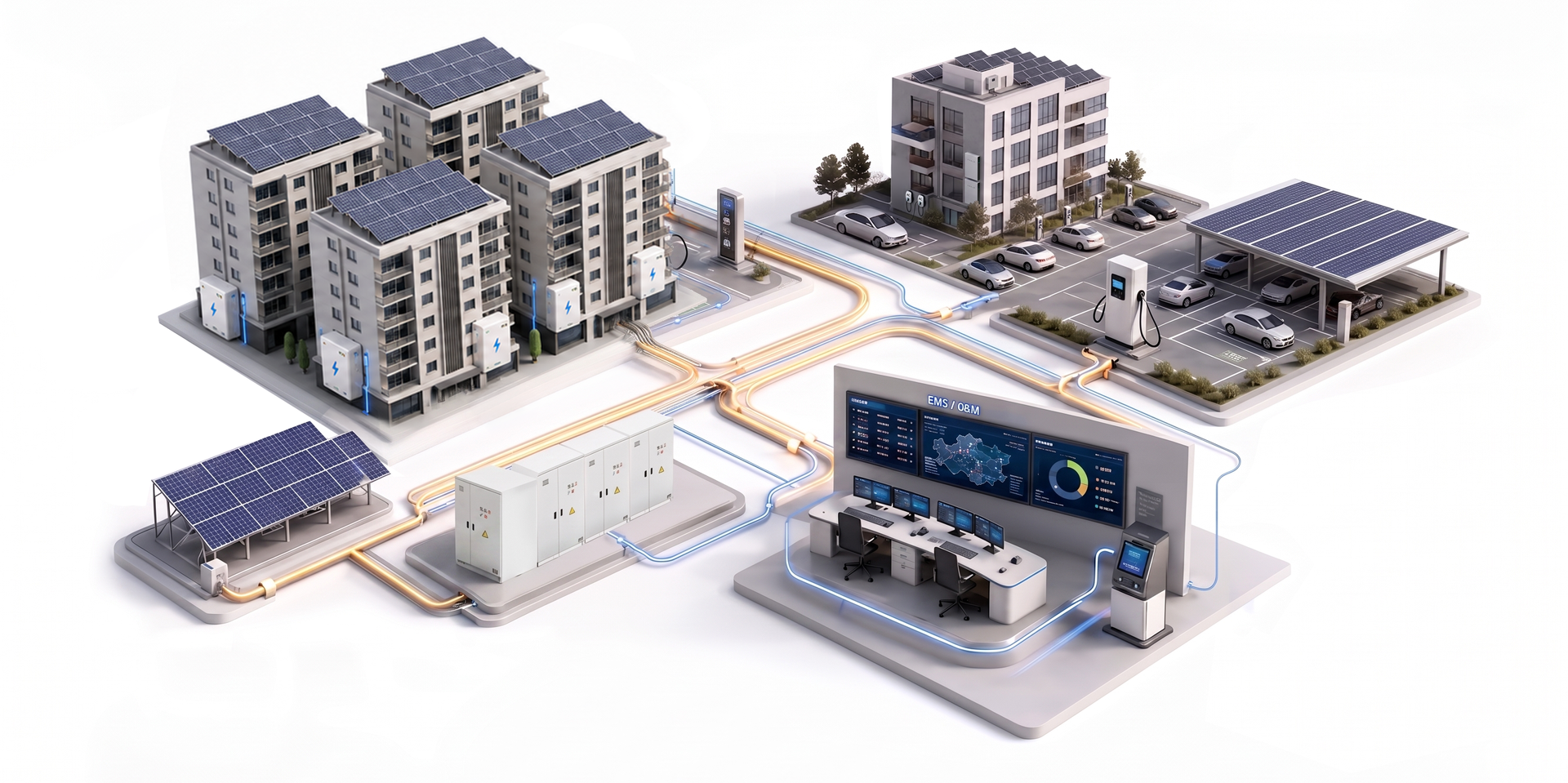
With growing EV charging demand, rooftop solar, and distributed storage, residential communities, parking sites, office buildings, and small commercial sites are becoming energy nodes that can generate, store, charge, and manage power.
Billion Group integrates solar PV, storage, EV charging, energy management, communications, and deployment support to build scalable, manageable distributed energy applications.
From Single-Site Equipment to
Managed Distributed Energy Nodes
When residential communities and small to mid-sized sites adopt energy systems, the key is no longer just the equipment itself. It also involves multi-point electricity use, charging loads, generation data, equipment status, and long-term O&M needs.
Billion Group helps residential communities, community parking areas, office and retail sites, small commercial facilities, and public charging stations integrate EV charging, solar PV, storage, communications, and monitoring capabilities based on site conditions and energy demand—making distributed energy equipment visible, manageable, and ready for future expansion.

Residential Communities

Community Parking Areas

Office & Retail Sites

Small Commercial Sites
Public
Charging Stations
From Assessment to O&M,
Supporting Distributed Energy Deployment
Distributed energy deployment requires integrated planning across site conditions, energy demand, equipment configuration, communication connectivity, and long-term management. Billion Group combines EV charging, solar PV, storage, energy management, communication platforms, system integration, and O&M services to help residential communities, commercial parking facilities, public charging stations, and small to mid-sized business sites build energy solutions that are deployable, manageable, and ready for long-term operation.
Distributed Energy Management Is Evolving into Infrastructure Planning
As EV charging, rooftop solar, self-consumption, and user-side storage continue to grow, communities, parking facilities, office buildings, and small commercial sites need more than standalone equipment. They need a site-level energy framework that can manage multi-point energy use, control charging loads, monitor equipment status, and support ongoing operations.
Rising Charging Demand and Load Challenges
Charging facilities are becoming a standard feature in communities and office buildings. Without proper load management and power planning, sites may face capacity constraints, higher peak loads, and increased management complexity.
Energy Autonomy and Resilience Needs
Sites are placing greater emphasis on self-consumption and backup capability. By integrating monitoring across solar PV, storage, and charging equipment, they can improve energy efficiency and strengthen response to abnormal conditions.
Policy, Regulation, and Compliance Progress
Subsidy programs and user-side storage regulations are accelerating market maturity. Customers need energy configurations that are compliant, scalable, and built to support long-term O&M.
Integrated Charging, Solar, Storage, and Site Management for
Operable Energy Nodes
Home / Community Charging & Load Management
For residential communities, apartment complexes, parking facilities, and shared charging sites
Integrating AC chargers, DC fast chargers, and load management to build scalable charging infrastructure while reducing capacity pressure and peak-load impact.
Rooftop Solar & Self-Consumption
For residential communities, small commercial sites, office buildings, retail spaces, and public parking facilities
Integrating rooftop solar, PV inverters, and site energy management to increase renewable self-consumption and turn sites into manageable energy generation and consumption nodes.
Distributed Backup & Microgrid Integration
For communities, apartment parking areas, small commercial sites, and weak-grid environments
Integrating small-scale storage, site monitoring, and remote management to enable backup power, monitoring, and basic dispatch for distributed energy points—building manageable microgrid nodes.
From Solar-Storage-Charging Equipment to Site Management,
Connecting the Capabilities Behind Distributed Energy Applications
For distributed energy systems in residential communities, parking facilities, office buildings, and small to mid-sized commercial sites to operate reliably over the long term, the key is not only equipment deployment. It also depends on the seamless connection of power generation, storage, charging, communications, and remote management.
Through cross-business collaboration, Billion Group integrates energy equipment, site communications, cloud management, system configuration, and deployment support to help customers build distributed energy application frameworks that are practical, manageable, and scalable—from needs assessment and solution planning to site deployment, remote management, and O&M services.
Solar-Storage-Charging Equipment
Supports power generation, storage, charging, and energy allocation for residential, community, and small commercial sites.
System Configuration & Deployment Support
Supports distributed energy applications from solution configuration and equipment deployment to cloud monitoring setup and maintenance support.
Integrated Solar-Storage-Charging Applications for
Distributed Energy Deployment
Solar-Storage-Charging Integration|Residential & Commercial Applications
Integrates solar PV, energy storage, EV charging, and smart energy management to support daily power use, EV charging, self-consumption, and backup needs for residential and commercial sites—improving renewable energy use and reducing energy costs.
Distributed Energy Node|Island and Weak-Grid Microgrid Applications
Integrates solar PV, storage, PCS, EMS, and on-site power demand to support stable power supply for agriculture, fisheries, and off-grid environments, demonstrating distributed energy integration for weak-grid and island applications.